Sodium Persulfate Supplier vs Factory: What Is the Difference?
A practical sourcing guide for overseas industrial buyers to understand the difference between a sodium persulfate factory, supplier and trading company, and why price should not be the only factor when choosing a long-term supply partner.
This article explains the difference between a sodium persulfate supplier, factory and trading company. It helps overseas buyers understand why they should check not only price, but also product documents, packing, dangerous goods export support, stable supply and communication efficiency before placing an order.
By Roger | DEGUSA CHEMICAL Team
Published: May 21, 2026
Updated: May 21, 2026
When overseas buyers search for sodium persulfate, they may see different terms such as factory, manufacturer, supplier, exporter and trading company. These words are sometimes used together, but they do not always mean the same thing.
For industrial chemicals such as sodium persulfate, the difference matters. Buyers are not only purchasing a product. They also need stable quality, COA, MSDS/SDS, TDS, proper packing, dangerous goods export support and reliable shipment coordination.
This guide explains the difference between a sodium persulfate supplier and factory, and what buyers should check before choosing a supply partner.
Quick Answer: What Is the Difference Between a Sodium Persulfate Supplier and Factory?
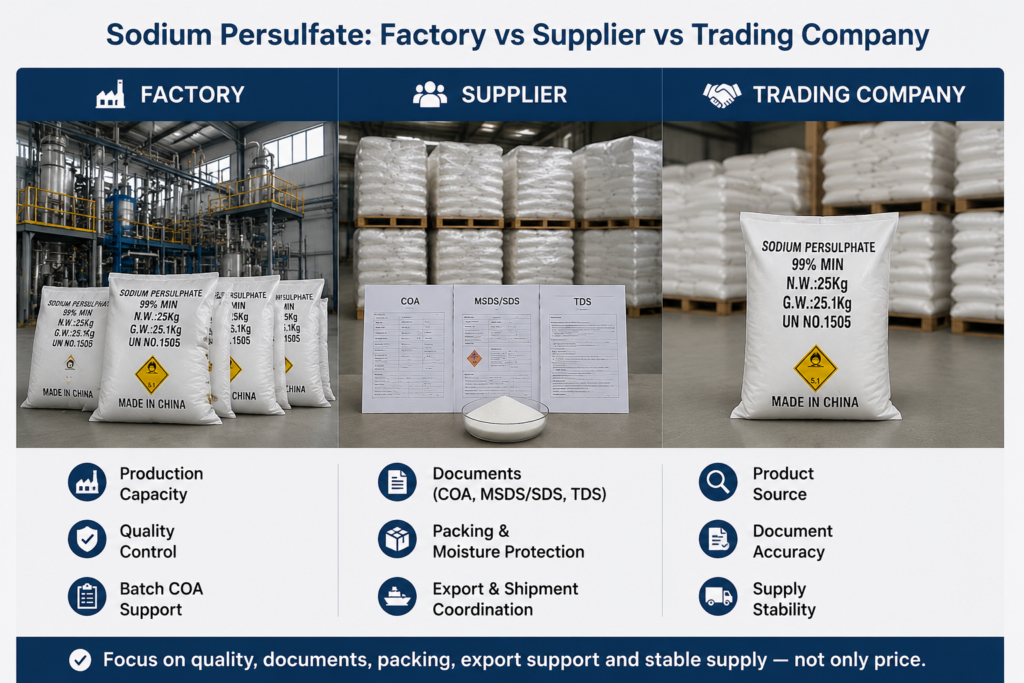
A sodium persulfate factory is usually responsible for production. A sodium persulfate supplier may provide factory-backed supply, technical documents, packing confirmation, export coordination and customer communication. A trading company may focus more on sourcing and resale, and its real control over production, documents and shipment support can vary.
For industrial buyers, the best choice is not always the lowest quotation. Buyers should check whether the supplier can provide stable product quality, COA, MSDS/SDS, TDS, proper 25kg packing, Class 5.1 dangerous goods export support and clear communication.
1. What Is a Sodium Persulfate Factory?
A sodium persulfate factory usually refers to the production side. It is responsible for manufacturing the product, controlling production conditions and supporting basic quality consistency.
For buyers, a factory can be important because it is closer to the production process. A factory may have better control over production capacity, batch quality, raw material planning and product availability.
When checking a sodium persulfate factory, buyers may ask:
- Does the factory produce sodium persulfate directly?
- What is the annual production capacity?
- Is the production stable for repeated orders?
- Can batch COA be provided?
- Is ISO or other quality management support available?
- Can the factory support long-term supply planning?
However, buying directly from a factory does not always mean the whole purchasing process will be easier. Some factories may be strong in production but less experienced in overseas communication, document preparation, export coordination or customer follow-up.
2. What Is a Sodium Persulfate Supplier?
A sodium persulfate supplier is usually the company that supports buyers throughout the sourcing and purchasing process. A supplier may be connected with production, sales, technical document preparation, packing confirmation and export coordination.
For overseas industrial buyers, a good supplier should help connect factory supply with real purchasing needs. This is especially important when buyers need clear specifications, export documents, shipment support and quick communication.
A reliable sodium persulfate supplier should support:
- Product specification confirmation
- COA, MSDS/SDS and TDS support
- Packing details and packaging photos
- 25kg bag or palletized packing discussion
- Class 5.1 dangerous goods export coordination
- Communication with freight forwarders
- Shipment follow-up
- Long-term supply communicatio
For many buyers, a supplier with factory-backed supply and export experience can be more practical than simply choosing the cheapest quotation.
3. What Is a Trading Company?
A trading company usually buys products from other manufacturers and resells them to customers. Some trading companies are professional and helpful, especially when they have strong sourcing ability and good communication. However, the buyer needs to check how much control the trading company has over product quality, documents, packing and shipment arrangements.
The risk is not that a trading company is always bad. The real issue is transparency. Buyers should know where the product comes from, whether documents can be provided correctly, and whether the supplier can support problems if they happen during production or export.
When working with a trading company, buyers may need to ask:
- Can the original product specification be provided?
- Can batch COA be provided?
- Can MSDS/SDS and TDS be provided?
- Is the packing information clear?
- Who is responsible for export documentation?
- Who will communicate with the freight forwarder?
- Can stable supply be supported for repeat orders?
For sodium persulfate, this is important because the product is an oxidizing chemical and export handling cannot be treated casually.
4. Supplier vs Factory vs Trading Company: Simple Comparison
The table below gives a simple comparison for industrial buyers:
Type | Main Role | Possible Strength | What Buyers Should Check
Factory | Produces sodium persulfate | Production control and capacity | Quality system, capacity, COA, direct product knowledge
Supplier | Supports sourcing, documents and export | Communication, document support, shipment coordination | Factory-backed supply, COA, MSDS/SDS, TDS, packing and export support
Trading Company | Sources and resells products | Flexible sourcing and communication | Product source, document accuracy, export responsibility and supply stability
In real purchasing, these roles may overlap. Some suppliers are connected with factories. Some manufacturers also have export teams. Some trading companies may also work closely with stable factories.
For buyers, the key question is not only the label. The key question is whether the company can support stable quality, correct documents, proper packing and reliable shipment.
5. Why Buyers Should Not Only Compare Price
Price is important, but it should not be the only factor when sourcing sodium persulfate.
A very low quotation may look attractive at first. However, if the supplier cannot provide proper documents, stable supply, suitable packing or export coordination, the final purchasing cost may become higher.
For sodium persulfate buyers, risks may include:
- Specification mismatch
- Missing or unclear COA
- Outdated MSDS/SDS
- No TDS for technical evaluation
- Unclear packing details
- Poor moisture protection
- Delayed shipment
- Dangerous goods booking problems
- Poor communication after payment
- Unstable repeated supply
For industrial buyers, a better question is not only “Which supplier is cheaper?” but also “Which supplier can help us complete the order safely and reliably?”
6. Documents Are Part of the Product
For industrial chemical sourcing, documents are not just paperwork. They are part of the product supply.
Before confirming an order, buyers should ask whether the supplier can provide:
- COA: Certificate of Analysis
- MSDS/SDS: Material Safety Data Sheet / Safety Data Sheet
- TDS: Technical Data Sheet
- Packing information
- Product photos or packaging photos
- Export-related documents when required
A COA helps buyers confirm batch quality. An MSDS/SDS helps buyers understand safety, handling, storage and transportation information. A TDS helps buyers evaluate technical suitability.
If a supplier cannot provide these documents clearly, buyers should be careful before placing an order.
7. Export Support Matters for Sodium Persulfate
Sodium persulfate is an oxidizing chemical and is commonly handled as Class 5.1 dangerous goods for transport. This means export support is an important part of supplier evaluation.
Even if the product quality is acceptable, poor export preparation can still cause shipment problems. For example, the freight forwarder may need the latest MSDS/SDS for dangerous goods review. Packing and labeling details may need to be checked. Shipment documents must also be prepared correctly.
Buyers should check whether the supplier can support:
- Dangerous goods information
- MSDS/SDS for logistics review
- Packing confirmation
- Communication with freight forwarders
- Export document preparation
- Container loading coordination
- Shipment follow-up
A supplier with export coordination experience can help reduce delays and communication problems during shipment.
8. Stable Supply Is Important for Repeat Orders
Many sodium persulfate buyers are not purchasing for one-time use only. Buyers in PCB etching, polymerization, water treatment and environmental remediation may need repeated supply.
For repeat orders, buyers should check whether the supplier can support stable product quality and stable delivery. This is especially important when raw material prices fluctuate or market supply becomes tight.
Useful questions include:
- Can the supplier support regular orders?
- Is production capacity stable?
- Can the supplier provide updated price validity?
- Can the supplier keep communication clear during market changes?
- Can the supplier support the same or similar specification for repeat orders?
- Can shipment be arranged according to the buyer’s schedule?
A supplier who understands long-term industrial purchasing can help buyers plan inventory and reduce supply risk.
9. How Buyers Can Evaluate a Sodium Persulfate Supply Partner
Before choosing a sodium persulfate supplier or factory, buyers can use the following checklist:
Evaluation Point | What Buyers Should Confirm
Product source | Whether the product is factory-backed
Specification | Whether the grade matches the intended application
Documents | COA, MSDS/SDS and TDS availability
Packing | 25kg bags, pallet options and moisture protection
Export support | Class 5.1 dangerous goods coordination
Communication | Clear replies and practical advice
Supply stability | Ability to support repeat orders
Application knowledge | Understanding of PCB etching, polymerization, water treatment or soil remediation
Long-term value | Quality, documents, shipment and service, not only price
This checklist helps buyers compare suppliers more practically. It also helps avoid choosing a supplier based only on a low price.
Why Choose DEGUSA CHEMICAL for Sodium Persulfate Supply?
DEGUSA CHEMICAL is operated by Xiamen Degusa Chemical Technology Co., Ltd., and supports overseas industrial buyers with sodium persulfate, potassium persulfate and ammonium persulfate supply.
We support buyers with product information, COA, MSDS/SDS, TDS, packaging details, export coordination and communication for qualified business inquiries.
DEGUSA CHEMICAL supports buyers with factory-backed supply and export coordination.
For more product details, buyers can visit our Sodium Persulfate product page.
Buyers can also learn more about our company background and production support on our About Us page.
FAQ
Is a sodium persulfate factory always better than a supplier?
Not always. A factory may have production control, but a good supplier may provide better communication, document support, export coordination and customer follow-up. Buyers should check the full supply capability, not only the company label.
What is the difference between a sodium persulfate supplier and a trading company?
A supplier may support product sourcing, technical documents, packing and export coordination. A trading company usually sources and resells products. Some trading companies are professional, but buyers should check product source, document accuracy and supply stability.
Why should buyers not only compare sodium persulfate prices?
A low price may not include stable quality, correct COA, updated MSDS/SDS, TDS, proper packing or dangerous goods export support. For industrial chemicals, these factors can affect the final purchasing result.
What documents should sodium persulfate buyers ask for?
Buyers should usually ask for COA, MSDS/SDS and TDS. Depending on the shipment and destination market, packing details, product photos and export-related documents may also be required.
Can DEGUSA CHEMICAL support factory-backed sodium persulfate supply?
Yes. DEGUSA CHEMICAL supports overseas industrial buyers with factory-backed sodium persulfate supply, technical documents, packaging details and export coordination for qualified business inquiries.
Conclusion
When comparing a sodium persulfate supplier vs factory, buyers should not focus only on the company label or the lowest price. A practical supply partner should support product quality, factory-backed supply, technical documents, packing confirmation, dangerous goods handling and export coordination.
For overseas industrial buyers, the better choice is usually the partner who can help complete the order safely, clearly and reliably.
For product specifications and supply details, visit our Sodium Persulfate product page or learn more about DEGUSA CHEMICAL on our About Us page.
Content Review Note
This article is intended for general industrial purchasing reference. Product source, specifications, packing, documents, classification, storage and shipment requirements should always be confirmed based on the latest COA, MSDS/SDS, TDS, contract terms and destination market regulations before placing an order.
Author Note
This article was prepared by Roger from DEGUSA CHEMICAL Team, based on our daily work in persulfate product supply, technical document preparation, packaging confirmation, dangerous goods export coordination and communication with overseas industrial buyers.
DEGUSA CHEMICAL is operated by Xiamen Degusa Chemical Technology Co., Ltd. We support sodium persulfate, potassium persulfate and ammonium persulfate supply for industrial applications such as PCB etching, polymerization, water treatment, soil remediation and other oxidation processes. We can provide product information, COA, MSDS/SDS, TDS, packaging details and export coordination support for qualified business inquiries.